Frequently asked questions
Everything buyers usually ask about new and used carts, electric vs. gas, financing, street-legal rules, and more — organized by topic.
New, used, and everything in between
See full buying guide →Should I buy a new or used golf cart?
A new golf cart offers a full warranty and the latest battery technology, while a used, dealer-reconditioned cart offers strong value for buyers who want reliable performance at a lower price.
What should I check before buying a used golf cart?
Check battery voltage and age, tire condition, the electrical system, and frame condition, and buy from a dealer that inspects carts before sale rather than a private listing with no documented history.
Can I test drive a golf cart before buying?
Yes, test drives are available on both new and used golf carts so you can get a feel for the cart before making a decision.
Does customizing a golf cart affect the warranty?
Customizations performed by an authorized dealer as part of the build typically preserve the manufacturer warranty, while some aftermarket modifications installed elsewhere afterward can affect coverage on certain components.
Choosing a power type
Compare electric options →What's the difference between electric and gas golf carts?
Electric carts are quieter, cheaper to run, and require less maintenance, making them ideal for neighborhoods and courses. Gas carts offer longer range and more torque, suited to hunting, farm, or heavy-duty use.
How long do lithium batteries last compared to lead-acid?
Lithium batteries generally last significantly longer than lead-acid batteries, with a much higher number of charge cycles, though exact lifespan varies by brand, usage, and care.
How far can a gas golf cart go on a full tank?
Most gas golf carts can travel well over 100 miles on a full tank, significantly farther than the typical electric golf cart's range on a single charge.
Can I retrofit my current golf cart with a lithium battery?
Many golf carts can be retrofitted from lead-acid to lithium batteries, though compatibility depends on the cart's existing electrical system, so it's worth having a specific cart evaluated first.
Paying for your cart
See financing options →What documents do I need to apply for golf cart financing?
Typical documents include a valid photo ID, proof of income, and proof of address, with a trade-in title if applicable. Specific requirements can vary by lender.
Can I get pre-qualified before I start shopping?
Yes, starting the financing conversation before you shop can help you know your budget range ahead of time, so you can focus on carts that fit.
Is financing available on used golf carts too?
Yes, financing options are available on used golf carts in addition to new models, not just higher-priced inventory.
Driving on public roads
Read the full LSV guide →What's the difference between a golf cart and a street-legal LSV?
A standard golf cart tops out around 20 mph and is generally restricted to golf courses and specific local roads. An LSV can reach 20 to 25 mph, meets federal safety standards, and can be titled, registered, and insured for public road use.
What equipment does a street-legal golf cart need?
Typically headlights, taillights and brake lights, turn signals, mirrors, seat belts, a windshield, reflectors, a parking brake, and a VIN, plus titling, registration, and insurance.
Can I drive a street-legal golf cart on any road?
No. LSVs are generally limited to roads posted at or below 35 mph and are prohibited from highways. Counties and cities can add further restrictions on top of state law, so check local ordinances.
How many seats do you need?
Compare seating options →What's the difference between forward-facing and rear-facing 4-seat golf carts?
A forward-facing 4-seat golf cart has two rows that both face forward, similar to a car, while a rear-facing model has a rear bench seat that faces backward.
Does every passenger need a seat belt on a 6 passenger golf cart?
Street-legal low-speed vehicle configurations require a seat belt for every seating position, including all 6 passengers, while standard off-road carts may not include belts at every position.
How much lift do I need on a golf cart?
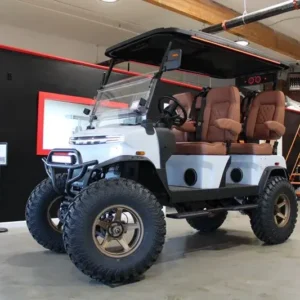
Smaller lift kits, around 3 to 4 inches, are often enough for light trails and uneven yards, while larger 6-inch or greater lifts suit rougher terrain and bigger tires.
Visiting our Ocala location
Get directions & contact info →Where is All About Golf Cars LLC located?
All About Golf Cars LLC is located at 2311 NW 10th St, Ocala, FL 34475, serving Ocala and Marion County.
What are your hours?
We're open Monday through Friday, 9:00 AM to 5:00 PM, and closed Saturday and Sunday.
Do you have a showroom I can visit?
Yes, our Ocala dealership has a showroom where you can see new and used golf carts in person, sit in different models, and compare brands side by side.
Still have a question?
Reach out directly and we'll get you a straight answer.